Frontier AI Is Now a U.S.-China Strategic Stability Issue
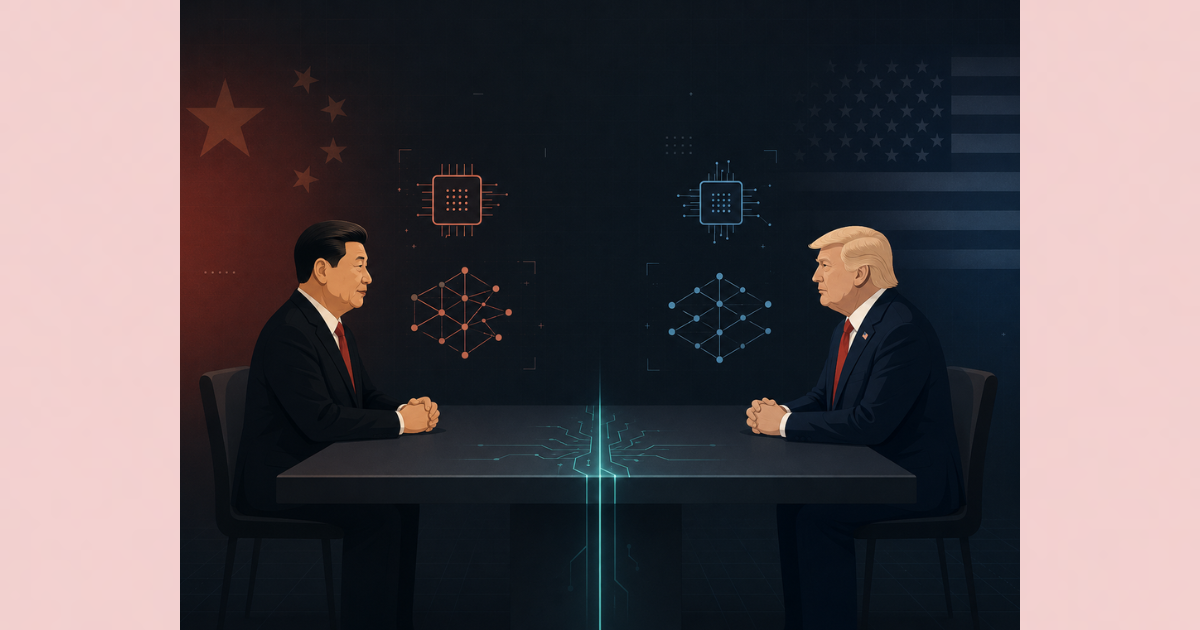
AI didn't end up on the upcoming Trump-Xi summit agenda because some policy staffer thought it would make a good talking point. It's there because it's moved out of the technology-policy lane and into the core architecture of great-power diplomacy.
The agenda itself shows how far that shift has already gone.
Reuters reported that Trump's May 14-15 talks with Xi in Beijing were expected to cover AI guardrails, a no-blame incident hotline, Nvidia H200 chip exports, and China's exclusion from early access to Anthropic's Mythos model.
What makes that combination significant is how much ground it compresses: four previously distinct policy domains—national security, export controls, frontier-model safety, and commercial access—folded into a single negotiation between two heads of state.
That compression changes what's actually being contested. The rivalry isn't primarily about who has the best model, the most compute, or the strongest semiconductor supply chain anymore. It's also about who gets trusted access to the most capable systems, who controls hardware bottlenecks, who defines what counts as safe deployment, and who carries liability when AI-enabled incidents cross borders.
Mythos and the asymmetric access problem
Anthropic's Mythos is the accelerant in this story. Reuters framed the summit pressure as rising after Mythos launched, with China excluded from early preview access and Chinese officials reportedly concerned that the model could be used by bad actors to attack Chinese software or financial systems.
For years, the U.S.-China AI contest was described in terms of capability: faster chips, larger training runs, better benchmarks, stronger military applications. Mythos shifts the conversation toward something harder to quantify—asymmetric access risk.
If a frontier model can meaningfully improve vulnerability discovery or autonomous exploitation, denying a rival state early access stops being a commercial decision. It becomes a strategic act. Washington's position is that restricting access is prudent risk management: don't give an adversary tools that could accelerate its offensive cyber capability.
Beijing's position is that the same restriction amounts to coercive vulnerability creation—a U.S.-aligned lab holds a system that may surface weaknesses in Chinese infrastructure, while China denies equivalent visibility into how the model behaves.
That gap in framing is why Mythos has become more than a model-release controversy. It's a live test case for whether frontier AI gets treated like software, like cloud infrastructure, like dual-use technology, or like something closer to a strategic capability subject to arms-control logic.
The H200 question is about leverage, not licensing
The Nvidia H200 situation sits on the other side of the same problem. The U.S. Commerce Department's Bureau of Industry and Security moved H200-class exports to China and Macau to a case-by-case license review process rather than treating them as automatically denied.
China deniesReuters later reported that chip export controls weren't a major topic in the bilateral talks and that progress on H200 deliveries remained stalled despite prior U.S. approval for some exports.
That stall matters because chips are the material layer of AI capability. Frontier models draw the headlines, but the deeper question is whether China can access enough high-end compute to train, fine-tune, and deploy frontier systems at scale.
The U.S. is trying to balance four competing pressures simultaneously: preserve American AI leadership, avoid pushing China into a full self-sufficiency sprint, keep Nvidia and other U.S. firms commercially viable, and prevent advanced chips from strengthening Chinese military or intelligence operations. China, meanwhile, has every incentive to reduce dependence on U.S.-controlled hardware while taking advantage of whatever access remains permitted in the near term.
Whether Nvidia can sell chips is almost beside the point. The real question is whether the U.S. still holds a controllable chokepoint in the AI stack.
Guardrails as diplomatic instrument
Reuters noted that the U.S. and China found narrow AI common ground in 2024, when Biden and Xi agreed that humans, not AI systems, should retain control over nuclear-use decisions. That agreement showed how strategic competitors can define red lines in extreme-risk domains even under broadly adversarial conditions.
The current agenda is harder to negotiate. Nuclear command-and-control is a relatively clean category—no state wants an autonomous system making launch decisions. Frontier AI, cyber operations, vulnerability discovery, autonomous agents, and hardware access are messier in every direction. The same model that helps secure code can help exploit it.
The same hardware that powers medical research can power military targeting or cyber automation. And a "guardrails" framework that looks like safety cooperation from Washington can look like strategic containment from Beijing.
A no-blame AI incident hotline would be meaningful but structurally limited for the same reason. It could help both sides communicate during suspected AI-enabled cyberattacks, model-driven market disruptions, or autonomous system incidents—but only if both sides trust that the other will answer, share accurate information, and not exploit the disclosure.
Reuters noted that a military-to-military hotline already exists, and U.S. officials have complained that China has frequently not picked up.
The institutional idea makes sense. The trust required to make it work doesn't yet exist.
Three contests, one room
AI doesn't fit neatly into older arms-control frameworks. Nuclear weapons are scarce, state-controlled, highly visible, and expensive to develop and test.
Advanced AI is diffuse, privately developed, cloud-deployed, globally accessible, and continuously changing. That's produced three overlapping contests that now appear to be converging into a single negotiating space.
- There's a model contest: which country's labs produce the most capable frontier systems?
- There's a compute contest: who controls the chips, data centers, energy infrastructure, and cloud capacity needed to build and operate those systems at scale.
- And there's a governance contest: who gets to define acceptable deployment, model access, safety evaluation, and incident accountability.
The Trump-Xi talks appear to have brought all three into the same room simultaneously—which is itself a significant development, regardless of what comes out of it.
What each side is actually seeking
The U.S. wants China to accept some form of AI risk management without that acceptance diluting U.S. technological advantage. That means guardrails, communication channels, and possibly shared safety principles—but not unrestricted Chinese access to the most capable models or chips.
China wants to avoid being structurally locked out of the frontier AI stack while resisting any framework that legitimizes U.S. control over model access, semiconductor exports, or safety definitions. Beijing doesn't want "AI safety" to function as a policy euphemism for strategic containment.
That leaves a narrow zone of possible agreement: catastrophic-risk language, human oversight of military escalation, and communication channels for AI-linked incidents. Agreement on the underlying material questions—who gets advanced compute, who gets frontier-model access, which AI capabilities are subject to restriction—is considerably less likely.
The bottom line
The reported AI agenda at the Trump-Xi summit matters because it treats frontier AI as a strategic stability issue rather than a commercial technology competition. Mythos represents the model-access problem. NVIDIA's H200 represents the compute-access problem.
The proposed hotline represents the escalation-management problem. The guardrails discussion represents the broader contest over who defines responsible AI in a geopolitically divided environment.
The most probable outcome isn't a comprehensive agreement. It's a limited framework: diplomatic language on safety, possible working groups, a hotline proposal, and continued disagreement on chips and frontier-model access.
But even that would cross a threshold. Once AI becomes a standing item in U.S.-China leader-level talks, it joins the short list of technologies treated as determinative of the balance of power.
The contest isn't only about building more capable systems anymore. It's about who's permitted to use them, who's permitted to inspect them, and who carries the consequences when they operate as instruments of state power.